There’s a question I hear fairly regularly from small business owners, and it usually goes something like this:
“Do I actually need a proper website? I’ve got Instagram, I’ve got Facebook, and I’ve heard you can just use AI to build something cheap these days.”
It’s a fair question. Social media is free. AI website builders are cheap and getting cheaper. And if your business is ticking along on word of mouth and a Facebook page, it can be hard to justify spending money on something that feels optional.
But here’s the thing a professional website isn’t optional. Not in 2026. And the businesses that treat it as one are quietly losing customers to the ones that don’t.
Let me explain why.
1. Your Customers Are Googling You — Whether You Like It or Not
Before a new customer calls you, emails you, or walks through your door, there’s a very good chance they’ve already looked you up online. Studies consistently show that the vast majority of consumers research a business online before making a purchasing decision and that number only increases every year.
What do they find when they search for you? If the answer is nothing, or a bare Facebook page with a handful of posts, that’s a trust problem before the conversation has even started.
A professional website gives you control over that first impression. It tells your story, showcases your work, answers the questions customers are asking, and gives them a clear, easy way to get in touch. It works for your business 24 hours a day, 7 days a week, without you having to be there.
A Facebook page cannot do all of that. Not reliably, and not on your terms.
2. Social Media is Borrowed Ground
I want to be clear I’m not anti social media, I use it. It’s a brilliant tool for building relationships, sharing your work, and staying visible with existing customers. Every business should be using it.
But here’s the problem: you don’t own it.
Facebook, Instagram, TikTok and all ofthese platforms are owned by companies whose priorities are not your business. They change their algorithms constantly, meaning your posts reach a fraction of your followers unless you pay for ads. They can restrict or suspend accounts without warning. They could shut down entirely, or fall out of favour the way MySpace and Vine did before them.
When that happens and for some platforms, when rather than if is the more accurate framing. Businesses that built everything on social media lose everything overnight.
Your website belongs to you. Your domain belongs to you. The content, the SEO rankings, the enquiry forms, the email list are all yours. Nobody can take that away. That’s not a small thing.
3. A Website Builds Trust in a Way Social Media Can’t
Think about the last time you were deciding between two businesses for something important. A tradesperson, a solicitor, a childcare provider. Did you just go with whichever one had more Instagram followers? Probably not.
You looked for something more substantial. A proper website with clear information, evidence of their work, testimonials from real clients, and professional presentation signals credibility in a way that a social media profile simply doesn’t.
This is especially true for trades businesses, professional services, and anyone asking customers to make a significant financial commitment. A well-built website communicates that you take your business seriously and by extension, that you’ll take their project seriously too.
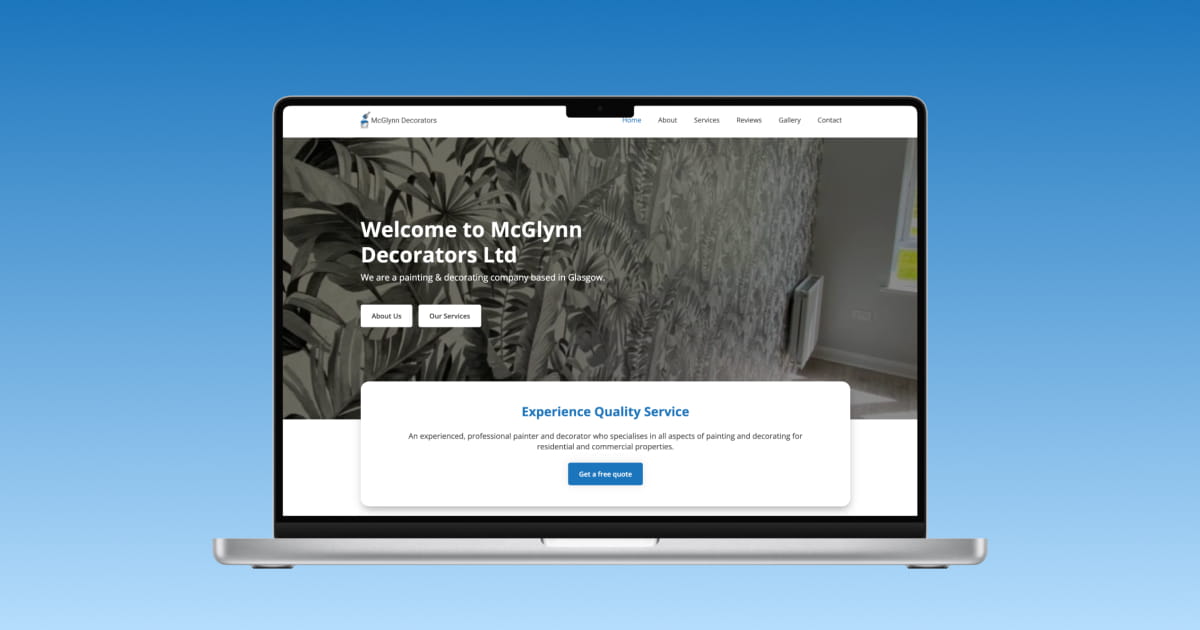
I’ve seen this first hand with clients. McGlynn Decorators in Glasgow saw a noticeable increase in enquiries and quote requests after their website launched, not because they changed anything about their service, but because their online presence finally matched the quality of their work.
4. Google Won’t Rank a Facebook Page the Way It Ranks a Website
Search engine optimisation or getting found on Google, is one of the most powerful and cost-effective ways a small business can generate new customers. And it requires a website.
A properly built and optimised website can appear in Google search results for the terms your potential customers are actually searching for. “Painter and decorator Glasgow.” “Youth football club North Lanarkshire.” “Freelance web designer Scotland.” These are real searches from real people with real intent to buy.
Social media profiles do sometimes appear in search results, but they rank far less reliably and offer far less control than a dedicated website with proper SEO in place. You cannot write targeted service pages, location-specific content, or keyword-optimised blog posts on a Facebook page.
A website is the foundation everything else sits on. SEO, Google Business Profile, local search visibility, all of it works better and works harder when there’s a strong website behind it.
5. AI Website Builders Are Not a Substitute for a Professional Build
This one needs addressing directly because it comes up a lot.
Yes, there are now AI-powered tools that claim to build you a website in minutes. Some of them produce something that looks passable at first glance. But there’s a significant gap between something that looks like a website and something that actually works as one.
The issues with AI-generated websites tend to cluster in a few areas:
- Generic design. They look like every other AI-built website because they’re drawing from the same pool of templates and patterns. There’s nothing that reflects your specific business, brand, or audience.
- Weak SEO. AI builders rarely produce well-structured, properly optimised sites. The technical SEO foundations — page titles, schema markup, site speed, internal linking — are often poor or missing entirely.
- No strategy. A good website is built around your business goals, your customers, and the actions you want visitors to take. An AI tool doesn’t know any of that. It just produces pages.
- Ongoing costs and lock-in. Many AI builders charge monthly fees indefinitely, and you often can’t take your site elsewhere if you want to leave. You’re renting, not owning.
For a hobby project or a very early stage idea, an AI builder might be fine to get something online quickly. For a business you’re serious about, it’s a false economy.
6. The Numbers Make Sense
Let’s talk about return on investment for a moment, because this is where a professional website becomes very easy to justify.
A well-built WordPress website for a small business typically costs between £1,500 and £3,500. That’s a one-off investment — not a monthly fee, not an ongoing subscription. With a reasonable hosting and maintenance package on top, you’re looking at a relatively modest annual cost.
Now think about what one new customer is worth to your business. For a trades company, a single new client job might be worth £500, £1,000, or considerably more. For a professional services firm, a new contract could be worth tens of thousands. Even for a business with smaller average transaction values, a steady flow of new enquiries through a website quickly dwarfs the initial investment.
A website that generates even two or three new enquiries a month pays for itself within the first year. Most well-built sites do considerably better than that.
Think of it as a member of staff who never sleeps, never calls in sick, and represents your business perfectly every single time. At £2,000–£3,000 for the build, that’s extraordinary value.
7. Your Competitors Are Already Doing It
This is perhaps the most practical point of all. Whatever industry you’re in, whatever part of Scotland you’re based in, your competitors with professional websites are winning customers that should be yours.
When a potential customer searches for your service in your area and finds a well-designed, informative, trustworthy website from a competitor — and nothing comparable from you — the decision is made before you even know there was a decision to be made.
A professional website doesn’t just help you compete. In many local markets across Scotland, it’s still enough to give you a genuine edge — because the bar is lower than you might think, and a well-built site stands out immediately.
So — Is a Professional Website Worth It in 2026?
Yes. Without question.
Not because social media doesn’t matter — it does. Not because AI tools are useless — they have their place. But because nothing else gives you the combination of ownership, credibility, search visibility, and round-the-clock sales capability that a professionally built website does.
In a world where the first place anyone looks for anything is Google, your website is your most valuable business asset. Treat it like one.
Ready to Invest in Your Business?
I’m William Dowling, a freelance web designer and developer based in Glasgow with 12+ years experience building custom WordPress websites for small businesses across Scotland.
If you’re ready to get a professional website that works as hard as you do, get in touch at hi@williamdowling.dev or head to the contact page and let’s talk about your project. No jargon, no hard sell — just an honest conversation about what you need and what it would cost.